 United Kingdom, GBP
 United States, USD
 Canada, CAD
 Australia, AUD
 New Zealand, NZD
 European Union, EUR
 France, EUR
 Switzerland, CHF
 Germany, EUR

Key findings
Sex drive can vary considerably from one person to the next, and it can change for the same person over time. But does where you live have anything to do with how much desire you feel? Or, to put it a little more cheekily, which is America’s horniest state?
To find out, Lovehoney surveyed more than 2,500 Americans about their self-reported sex drive, partnered-sex frequency, masturbation habits, thoughts about sex, ideal sexual frequency, and satisfaction with their sex lives.
The headline finding is clear: Delaware has the highest average self-reported sex drive in the U.S., scoring 6.51 out of 10, compared with a national average of 5.79.
But the First State does not come first in every category. Delaware is not the state having the most partnered sex, thinking about sex most often, masturbating most frequently, or reporting the greatest sexual satisfaction. Each of those titles belongs to a different state, showing that sex drive is more complicated than any single number.
Delaware has the highest average sex drive in America, at 6.51 out of 10. Virginia ranks second at 6.47, followed by Maryland at 6.38.
New Mexico reports the most partnered sex, averaging 9.96 times per month, around 72% more than the national average of 5.79.
Different states lead every major measure: Texas masturbates most frequently, Montana is most likely to think about sex multiple times per day, and New Hampshire reports the greatest sexual satisfaction.
More than half of Americans want more sex than they are having, with 56% saying they engage in sexual activity less often than they would ideally like.
People in committed relationships who live apart report the highest sex drives, averaging 6.58 out of 10, while people living with a partner report the most frequent partnered sex.
The states with the highest sex drives
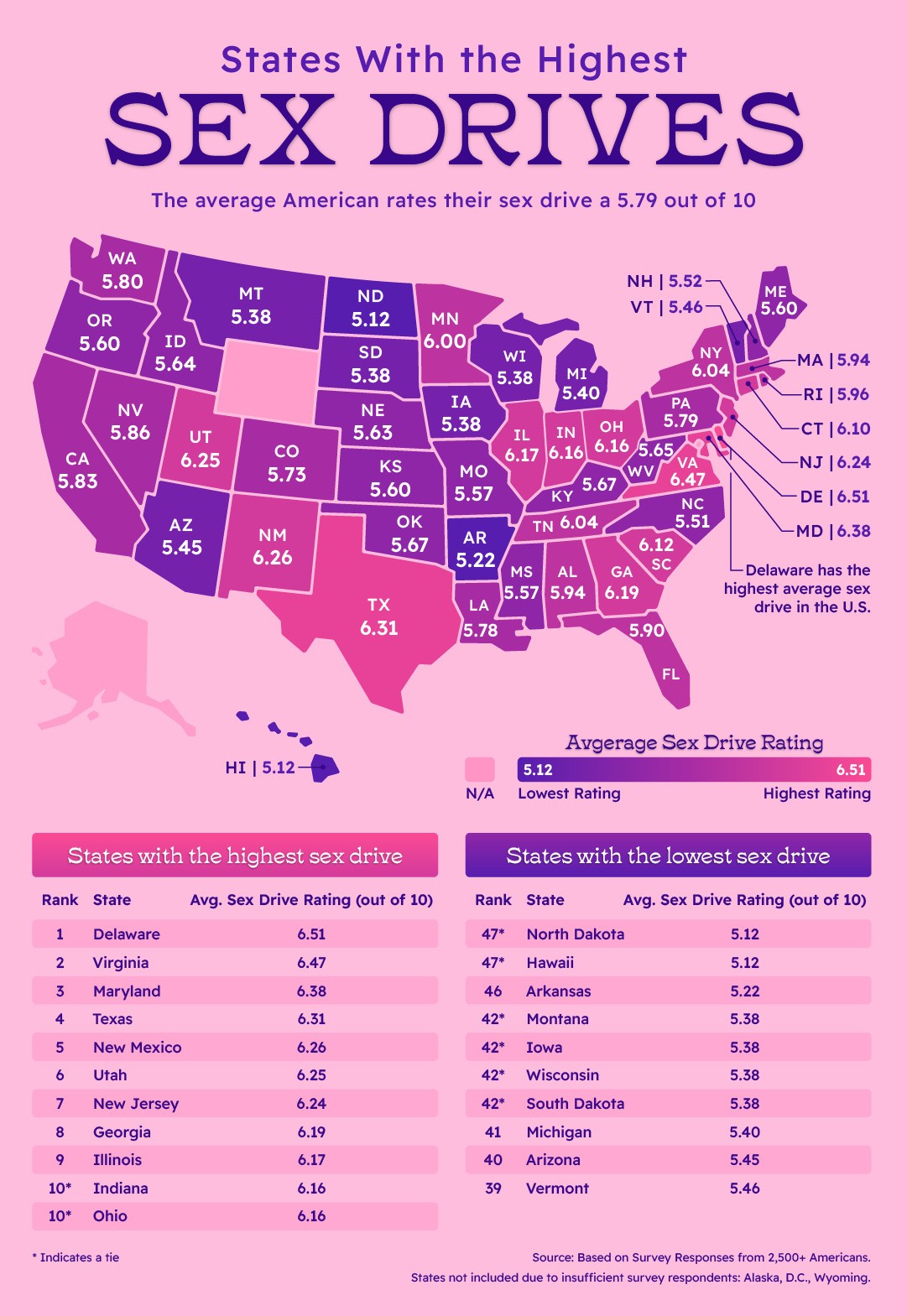
Delaware comes first in our ranking, with residents rating their current sex drive an average of 6.51 out of 10, placing the state 0.72 points above the national average of 5.79.
The Mid-Atlantic dominates the top of the list. Virginia follows Delaware with an average rating of 6.47, while Maryland ranks third at 6.38. Less than 0.15 points separates all three states.
Texas takes fourth place with a score of 6.31, and New Mexico completes the top five at 6.26. Utah, New Jersey, Georgia, Illinois, Indiana, and Ohio make up the rest of the top 10 positions, with Indiana and Ohio tied.
| Rank | State | Average sex drive rating |
|---|---|---|
| 1 | Delaware | 6.51/10 |
| 2 | Virginia | 6.47/10 |
| 3 | Maryland | 6.38/10 |
| 4 | Texas | 6.31/10 |
| 5 | New Mexico | 6.26/10 |
| 6 | Utah | 6.25/10 |
| 7 | New Jersey | 6.24/10 |
| 8 | Georgia | 6.19/10 |
| 9 | Illinois | 6.17/10 |
| 10, tie | Indiana | 6.16/10 |
| 10, tie | Ohio | 6.16/10 |
At the other end of the ranking, Hawaii and North Dakota share the lowest average rating at 5.12 out of 10. Arkansas follows at 5.22, while Iowa, Montana, South Dakota, and Wisconsin are tied at 5.38.
Even so, the difference between the highest and lowest state averages is only 1.39 points. Delaware is above average, but it is not reporting an off-the-charts 9 or 10 while another state sits near zero. The results suggest some geographic variation, but they also show that Americans’ average sex drives remain relatively close across the country.
Nationally, respondents rate their sex drive 5.79 out of 10. Around 58% somewhat or strongly agree that they are highly sexual, and 66% say they experience sexual desire several times per week or more.
Among respondents who identify as men or women, men report a higher average sex drive at 6.57, compared with 5.26 among women. We explore those demographic differences in more detail below.
A high sex drive doesn’t necessarily mean having more sex
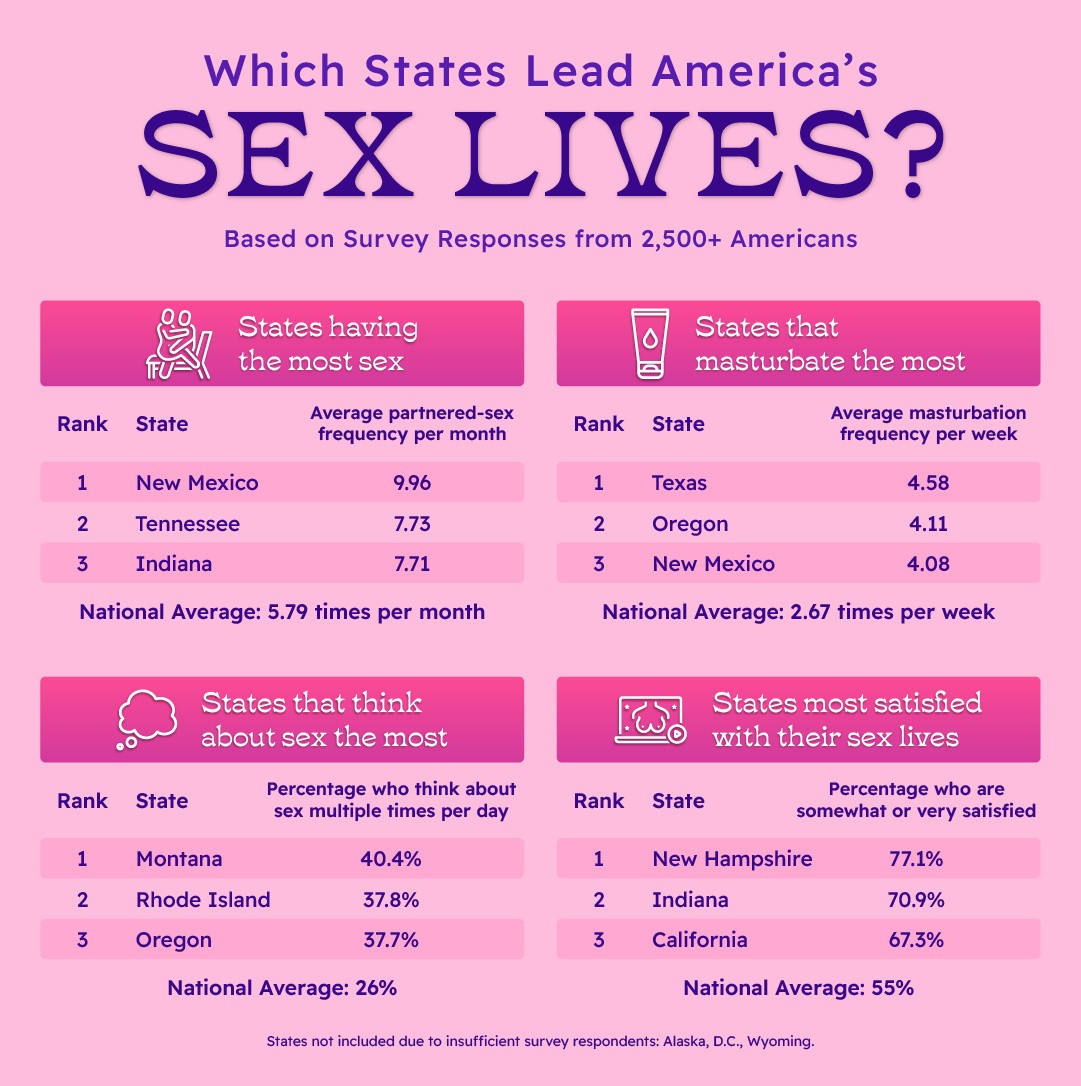
Delaware residents report the highest sex drive, but a different state takes the top spot when it comes to how often Americans are actually having partnered sex.
New Mexico reports the most partnered sex in America, with residents averaging 9.96 times per month. That is around 72% higher than the national average of 5.79 times per month.
Tennessee ranks second at 7.73 times per month, narrowly ahead of Indiana at 7.71. Texas follows at 7.70, while Utah completes the top five at 7.27.
| Rank | Highest reported frequency | Times per month | Lowest reported frequency | Times per month |
|---|---|---|---|---|
| 1 | New Mexico | 9.96 | Hawaii | 3.42 |
| 2 | Tennessee | 7.73 | Nevada | 3.44 |
| 3 | Indiana | 7.71 | Nebraska | 3.65 |
| 4 | Texas | 7.70 | Connecticut | 3.91 |
| 5 | Utah | 7.27 | Iowa | 4.19 |
Relationship status helps explain why desire and sexual frequency do not always move together. People in committed relationships who do not live together report the highest average sex drive at 6.58 out of 10, but those who live with a partner report the most partnered sex, averaging 8.8 times per month.
People in committed relationships who live apart average 7.57 times per month, while married respondents average 6.81. Singles and separated or divorced respondents report much lower frequencies, at 2.54 and 2.50 times per month, respectively.
In other words, feeling more desire does not always mean having more opportunities to act on it. Routine, proximity, relationship status, and everyday life can all affect what happens between the sheets.
Age also plays a role in reported activity. Adults aged 29 to 44 average partnered sex 6.6 times per month, compared with 3 times per month among adults aged 61 and older.
Which states think about sex and masturbation the most?
Partnered sex is only one part of the picture. Looking at masturbation and thoughts about sex produces another set of state leaders, along with a few unexpected contradictions.
Texas masturbates most often
Americans report masturbating an average of 2.67 times per week, but Texans are going solo more often than anyone else. Texas tops the ranking at 4.58 times per week, followed by Oregon at 4.11 and New Mexico at 4.08.
Ohio ranks fourth at 3.49 times per week, with Washington close behind at 3.48. At the bottom of the ranking are Alabama at 1.58, Indiana at 1.81, Idaho at 1.90, South Dakota at 1.91, and Tennessee at 1.92.
Tennessee offers one of the clearest examples of why these measures should not be treated as interchangeable. It ranks second for partnered sex but among the bottom five for masturbation. Texas, by contrast, performs strongly across both measures, ranking fourth for partnered sex and first for masturbation.
Montana thinks about sex most often
When respondents were asked how often they think about sex or sexual intimacy, 26% nationally said it crosses their minds multiple times per day.
Montana leads the country, with 40.4% of respondents saying they think about sex multiple times per day. Rhode Island follows at 37.8%, Oregon at 37.7%, Florida at 36.8%, and New Mexico at 36.7%.
The lowest shares are found in Oklahoma at 17.3%, North Carolina at 18.0%, North Dakota at 18.6%, Hawaii at 18.8%, and Arizona and Delaware at 19.6% each.
That puts Delaware near the bottom for frequent sexual thoughts, despite having the highest self-reported sex drive in America. Oregon creates the opposite kind of contrast. It ranks only 32nd for average sex drive, at 5.60 out of 10, but places second for masturbation and third for thinking about sex multiple times per day.
New Mexico is one of the most consistent performers across the behavioral measures. Along with having the most partnered sex, it ranks third for masturbation and fifth for thinking about sex multiple times per day. Even then, no single state dominates every part of America’s sex life.
Most Americans want more sex than they’re having
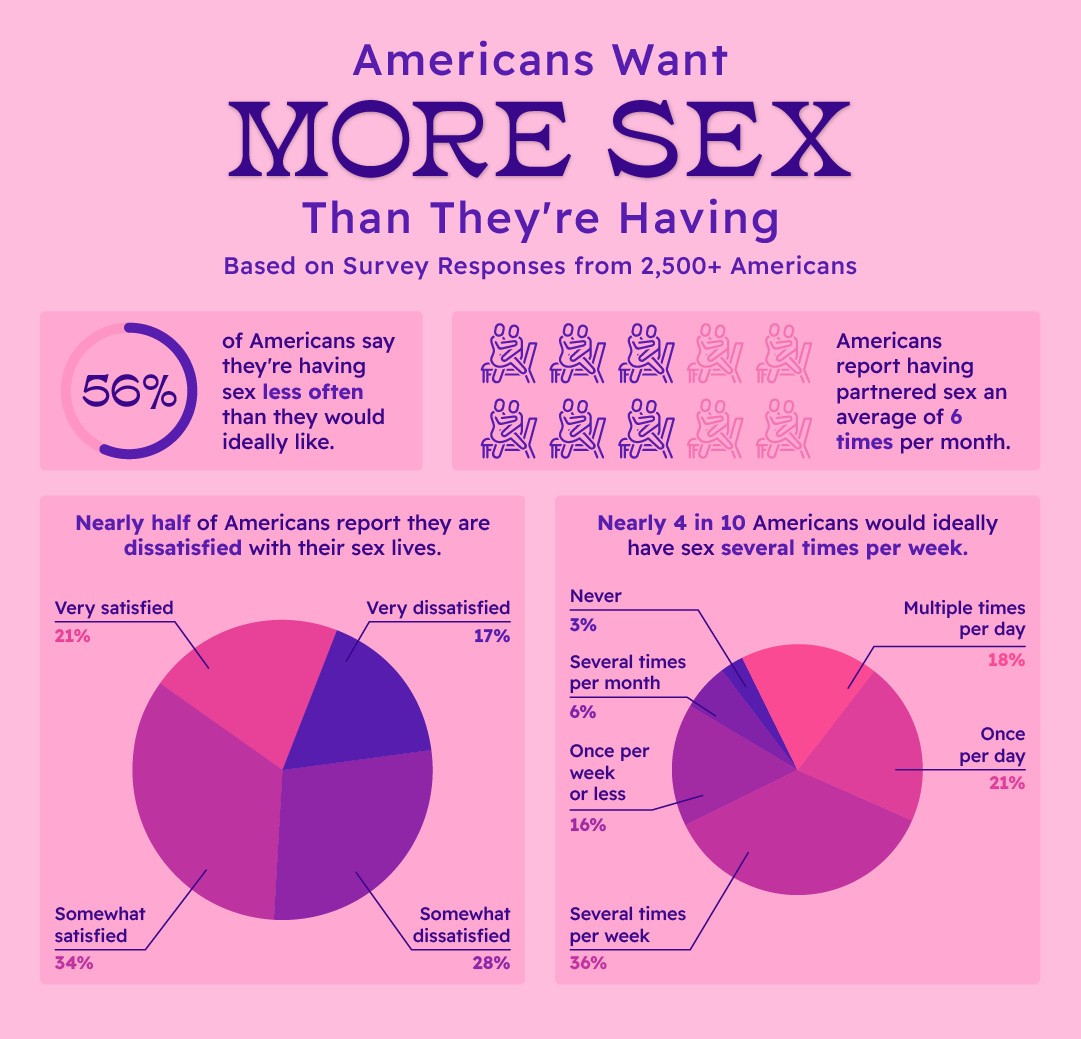
The gap between desire and reality is hard to miss. More than half of Americans, 56%, say they currently engage in sexual activity less often than they would ideally like. Only 30% say they are having sex about as often as they want.
If time, partner availability, responsibilities, and other practical barriers disappeared, 36% would ideally have sex several times per week, making it the most popular answer. Another 21% would choose once per day.
In reality, Americans report having partnered sex an average of about 5.8 times per month. That does not mean everyone wants or needs the same frequency, but it does show a widespread gap between what many people would like and what their day-to-day lives allow.
Wanting more sex also does not automatically mean being unhappy with your sex life. Nationally, 55% are somewhat or very satisfied, while 45% are somewhat or very dissatisfied. Only 21% describe themselves as very satisfied.
New Hampshire has the most sexually satisfied residents
New Hampshire has the highest share of residents who are somewhat or very satisfied with their sex lives, at 77.1%. Indiana follows at 70.9%, while California and Kansas are nearly tied at 67.3%. Tennessee rounds out the top five at 66.7%.
| Rank | Most satisfied state | Somewhat or very satisfied | Lowest satisfaction state | Somewhat or very satisfied |
|---|---|---|---|---|
| 1 | New Hampshire | 77.1% | Vermont | 38.0% |
| 2 | Indiana | 70.9% | Ohio | 38.8% |
| 3 | California | 67.3% | Iowa | 43.8% |
| 4 | Kansas | 67.3% | Nebraska | 44.9% |
| 5 | Tennessee | 66.7% | Hawaii | 45.8% |
The New Hampshire and Vermont contrast is particularly striking. The neighboring states sit at opposite ends of the satisfaction ranking, with a gap of more than 39 percentage points.
New Hampshire also shows why satisfaction is not the same thing as desire. Its average sex drive rating is 5.52 out of 10, below the national average, yet it has the country’s highest rate of sexual satisfaction.
Who has the highest sex drive?
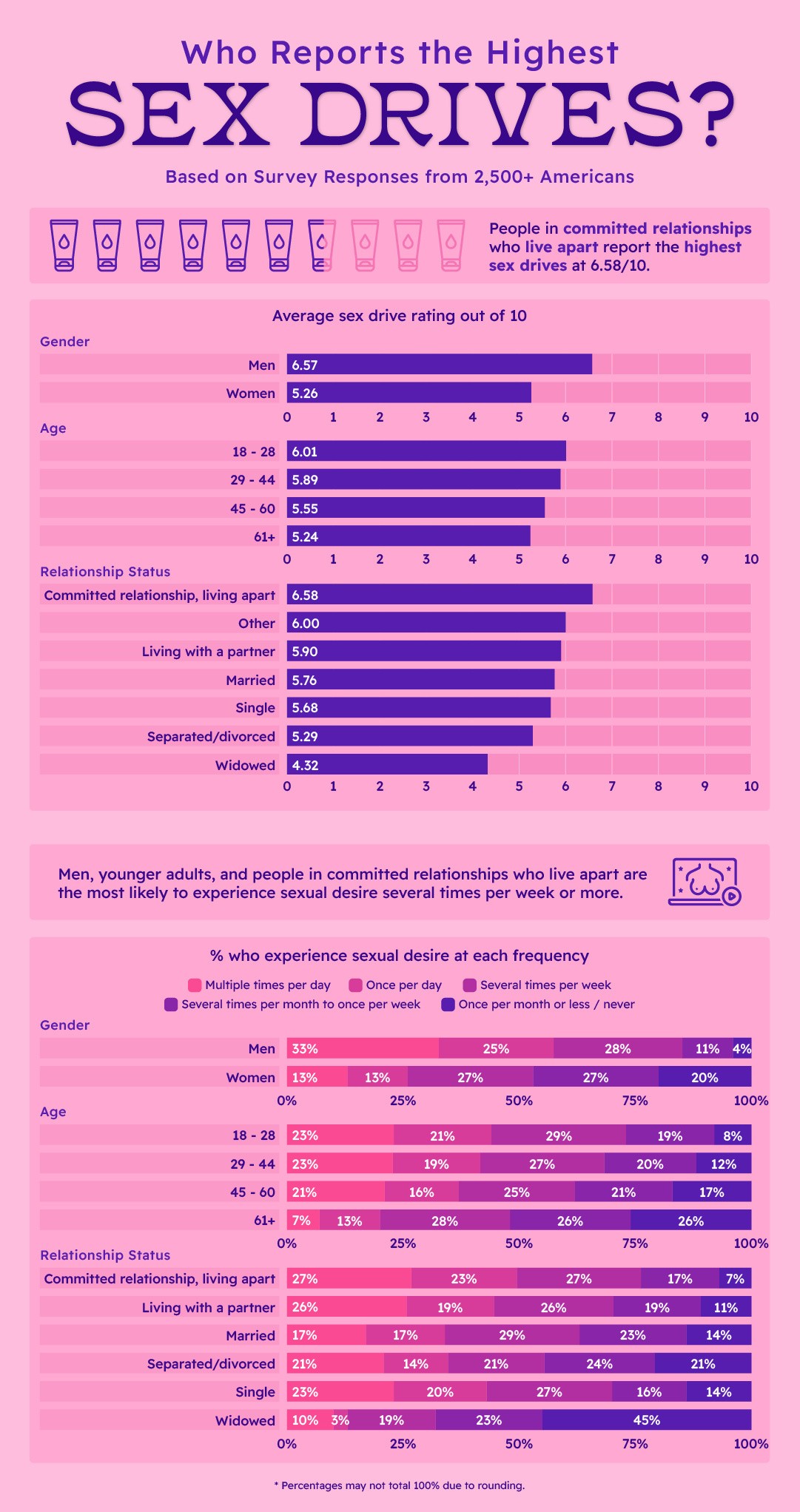
Location is only one way to look at libido. Relationship status, gender, and age reveal some of the survey’s clearest differences.
People in committed relationships who live apart report the highest sex drives
People in committed relationships who do not live together have the highest average sex drive of any relationship-status group, at 6.58 out of 10. That compares with 5.90 among people living with a partner, 5.76 among married respondents, and 5.68 among singles.
Nearly 73% of committed but non-cohabiting respondents also somewhat or strongly agree that they are highly sexual, the highest share of any relationship-status group.
The finding adds another layer to the desire-versus-opportunity story. Couples who live apart report the strongest desire, while people who share a home with a partner report the most frequent partnered sex.
Men report higher desire, but women are slightly more satisfied
Among respondents who identify as men or women, men rate their average sex drive at 6.57 out of 10, compared with 5.26 among women.
Men are also more than twice as likely to say they experience sexual desire multiple times per day, at 33% compared with 13% of women. They report masturbating an average of 3.8 times per week, compared with 1.8 times among women.
Higher reported desire does not translate into greater satisfaction, however. Women are slightly more likely to say they are very satisfied with their sex lives, at 23% compared with 19% of men.
Sex drive ratings generally decrease with age
Adults aged 18 to 28 report the highest average sex drive at 6.01 out of 10. The average falls to 5.89 among those aged 29 to 44, 5.55 among those aged 45 to 60, and 5.24 among adults aged 61 and older.
The difference is even clearer when looking at frequent desire. Around 23% of adults aged 18 to 28 experience sexual desire multiple times per day, compared with 7% of those aged 61 and older.
Reported partnered-sex frequency is highest among adults aged 29 to 44, at 6.6 times per month, and falls to 3 times per month among adults aged 61 and older. The oldest group is also the most likely to say they do not have a desired frequency for sex, with 13% choosing that response.
These are group averages, not rules for individuals. There is no universal amount of desire or sexual activity that someone should have at any age.
Sex drive is more than one number
The survey suggests there is no single way to define a high sex drive. Delaware leads the self-reported sex-drive ranking, New Mexico residents report the most partnered sex, Texans masturbate most frequently, Montanans are most likely to think about sex multiple times per day, and New Hampshire residents report the greatest sexual satisfaction.
That mismatch is the bigger story. Desire, activity, solo pleasure, sexual thoughts, and satisfaction overlap, but they are not the same thing. Relationship status, age, opportunity, and personal preferences can all shape how someone’s sex life looks and how they feel about it.
Nationally, Americans give their sex drives a middle-of-the-road 5.79 out of 10, yet 56% still say they are having sex less often than they would ideally like. Whether that means more partnered play, more solo pleasure, or simply a better match between desire and reality, there is no magic number. The right amount is the amount that feels right for you.
Methodology
Lovehoney surveyed more than 2,500 U.S. adults between June 25 and July 23, 2026. Respondents answered questions about their current sex drive, self-perceived sexuality, frequency of sexual desire, partnered sex, masturbation, current versus ideal sexual frequency, thoughts about sex, and sexual satisfaction.
The main state ranking is based on the average response to the question, “How would you rate your current sex drive?” on a scale from 1 to 10. Other state rankings use the average reported number of partnered-sex occasions per month, average masturbation frequency per week, the percentage who think about sex or sexual intimacy multiple times per day, and the percentage who are somewhat or very satisfied with their sex lives.
State-level rankings include only locations with sufficient response counts. Alaska, the District of Columbia, and Wyoming were excluded from the published state rankings because of insufficient sample sizes.
All findings are based on self-reported responses. Percentages and averages have been rounded, so totals may not always equal 100%. Rankings and ties are based on scores rounded to two decimal places.
The results describe the survey sample and do not establish that living in a particular state causes differences in sex drive or sexual behavior.
Fair Use
You are welcome to use, reference, and share non-commercial excerpts of this study with proper attribution. If you cite or cover our findings, please link back to this page so readers can view the full methodology, charts, and context.